Note
This page was generated from a Jupyter Notebook. Download the notebook (.ipynb)
[1]:
# Skipped in CI: Colab/bootstrap dependency install cell.
Segment Analysis: Basic Pipeline
Goal: Learn how to use SegmentTable to manage time-keyed data analysis.
SegmentTable is a container for metadata and payload data (like TimeSeries or PSDs) associated with specific time segments. It supports lazy-loading to handle large datasets efficiently.
1. Creating a SegmentTable
We’ll start by loading sample data from a CSV file. This CSV defines segments with GPS start and end times.
[2]:
import warnings

warnings.filterwarnings("ignore", category=UserWarning)
warnings.filterwarnings("ignore", category=DeprecationWarning)

from pathlib import Path

from gwexpy.table import SegmentTable

# Resolve the sample path robustly for both repo-root and notebook-dir execution.
csv_candidates = []
for root in [Path.cwd(), *Path.cwd().parents]:
    csv_candidates.extend([
        root / "docs" / "_static" / "samples" / "sample_segment_data.csv",
        root / "_static" / "samples" / "sample_segment_data.csv",
    ])

sample_csv = next((path for path in csv_candidates if path.exists()), None)
if sample_csv is None:
    tried = [str(path) for path in csv_candidates]
    raise FileNotFoundError(f"Could not find sample_segment_data.csv. Tried: {tried}")

st = SegmentTable.read(str(sample_csv))

print(st)
st.display().head()
   start  end label          span
0      0    4     A    (0.0, 4.0)
1      4    8     B    (4.0, 8.0)
2     10   13     C  (10.0, 13.0)
3     15   20     D  (15.0, 20.0)
4     22   25     E  (22.0, 25.0)
[2]:
| start | end | label | span | |
|---|---|---|---|---|
| 0 | 0 | 4 | A | (0.0, 4.0) |
| 1 | 4 | 8 | B | (4.0, 8.0) |
| 2 | 10 | 13 | C | (10.0, 13.0) |
| 3 | 15 | 20 | D | (15.0, 20.0) |
| 4 | 22 | 25 | E | (22.0, 25.0) |
2. Visualizing Segments
You can quickly visualize the timeline of your segments.
[3]:
import matplotlib.pyplot as plt

fig, ax = plt.subplots()
st.segments(ax=ax, label="Tutorial Segments")
plt.title("SegmentTable Timeline")
plt.show()
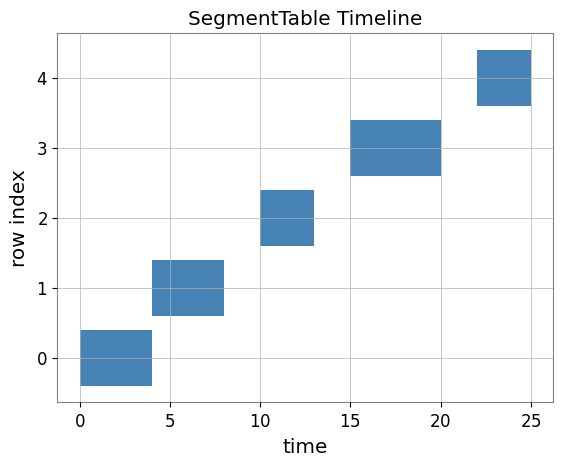
3. Lazy Loading Payloads
SegmentTable allows you to attach “loaders” to columns. Data is only loaded when actually accessed.
[4]:
from gwexpy.noise.wave import gaussian


def noise_loader(segment):
    # Generate synthetic noise for the segment
    duration = float(segment[1] - segment[0])
    return gaussian(duration=duration, sample_rate=1024, t0=float(segment[0]))

# Note: Use add_series_column for lazy-loadable payload data (kind='timeseries', etc.)
st.add_series_column("noise", loader=noise_loader, kind="timeseries")

# Accessing the first row's noise (triggers loading)
data_0 = st.row(0)["noise"]
print(f"Loaded {len(data_0)} samples starting at GPS {data_0.t0.value}")
Loaded 4096 samples starting at GPS 0.0
4. Processing Rows
You can iterate over rows or use apply to process data.
[5]:
# Calculate RMS for each noise segment
# Use add_column for lightweight metadata results
st.add_column("rms", data=[row["noise"].rms().value for row in st])
st.display()
[5]:
| start | end | label | span | rms | noise | |
|---|---|---|---|---|---|---|
| 0 | 0 | 4 | A | (0.0, 4.0) | 0.988632 | <timeseries: 4096 samples> |
| 1 | 4 | 8 | B | (4.0, 8.0) | 1.020706 | <timeseries: 4096 samples> |
| 2 | 10 | 13 | C | (10.0, 13.0) | 0.991075 | <timeseries: 3072 samples> |
| 3 | 15 | 20 | D | (15.0, 20.0) | 0.998533 | <timeseries: 5120 samples> |
| 4 | 22 | 25 | E | (22.0, 25.0) | 1.022016 | <timeseries: 3072 samples> |
5. Quick Check (NBMAKE)
[6]:
assert "noise" in st.columns
assert len(st) > 0
print("Validation successful!")
Validation successful!