Note
This page was generated from a Jupyter Notebook. Download the notebook (.ipynb)
[1]:
# Skipped in CI: Colab/bootstrap dependency install cell.
Case Study: Violin Mode Analysis

In gravitational-wave detectors, suspension fibres holding the mirrors resonate as stretched strings. Their modes — violin modes — appear as sharp Lorentzian peaks in the strain ASD.
This tutorial shows how to:
Model violin-mode peaks with
lorentzian_qFit an ASD to extract Q value, FWHM, and ring-down time
Batch-process multiple harmonics
Track a slowly drifting mode frequency through time
The physical goal is to distinguish a true suspension resonance from nearby control lines or broadband floor changes, then quantify whether its frequency and damping drift are consistent with thermal or mechanical changes in the suspension.
Prerequisites: Advanced Fitting
[2]:
import warnings

warnings.filterwarnings("ignore", category=UserWarning)
warnings.filterwarnings("ignore", category=DeprecationWarning)

import matplotlib.pyplot as plt
import numpy as np

from gwexpy.fitting.models import lorentzian_q
from gwexpy.frequencyseries import FrequencySeries
from gwexpy.timeseries import TimeSeries

plt.rcParams["figure.figsize"] = (10, 5)
1. Physics Background
The \(n\)-th resonant frequency of a fibre (length \(L\), tension \(T\), density \(\rho\), cross-section \(A\)):
KAGRA typical values: 1st violin ~170–190 Hz, 2nd ~340–380 Hz.
Each mode is a Lorentzian with quality factor \(Q = f_0/\text{FWHM}\):
Ring-down time constant: \(\tau = Q / (\pi f_0)\)
Common mistake: fitting a broad control feature or blended doublet as if it were one violin mode. A physically meaningful violin-mode fit should be narrow, isolated, and stable under modest changes of the fit window.
2. Synthetic ASD Data
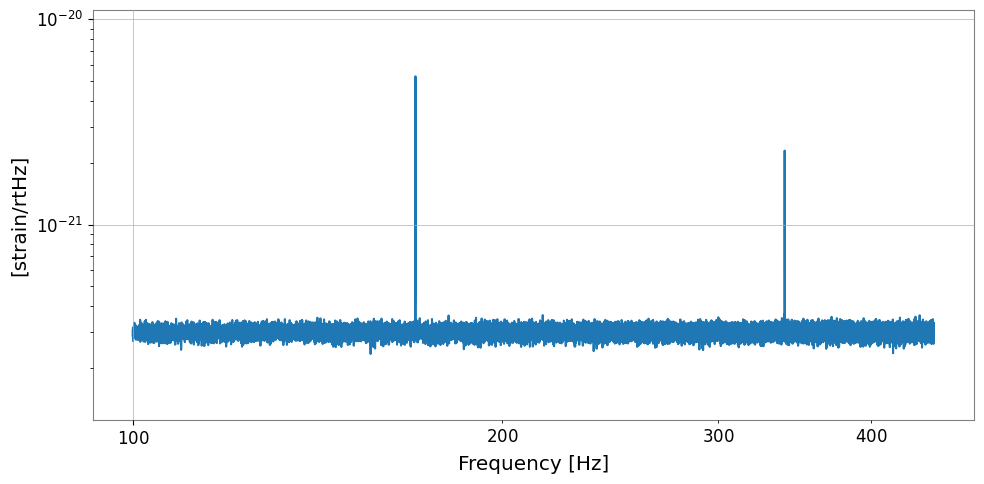
Generate a synthetic ASD with two violin modes on a flat background using lorentzian_q. The same function is used for fitting, so the model is self-consistent.
[3]:
rng = np.random.default_rng(42)

# ── Frequency axis: 100–450 Hz, df = 0.01 Hz ─────────────────────────────────
df    = 0.01   # Hz resolution
freqs = np.arange(100, 450, df)

# ── Flat background ASD ───────────────────────────────────────────────────────
BACKGROUND = 3e-22   # strain / sqrt(Hz)
background = np.ones_like(freqs) * BACKGROUND

# ── Violin modes (using lorentzian_q for both generation and fitting) ─────────
MODES = {
    "1st violin": {"f0": 170.0, "A": 5e-21, "Q": 1.0e4},
    "2nd violin": {"f0": 340.0, "A": 2e-21, "Q": 8.0e3},
}

asd_data = background.copy()
for cfg in MODES.values():
    asd_data += lorentzian_q(freqs, A=cfg["A"], x0=cfg["f0"], Q=cfg["Q"])

# Add small Gaussian noise
asd_data += rng.normal(0, BACKGROUND * 0.05, len(freqs))
asd_data  = np.clip(asd_data, 0, None)

asd = FrequencySeries(asd_data, frequencies=freqs,
                      unit="strain/rtHz", name="Synthetic DARM ASD")

print("Frequency range:", freqs[0], "–", freqs[-1], "Hz")
print("Modes inserted:")
for name, cfg in MODES.items():
    FWHM_true = cfg["f0"] / cfg["Q"]
    print(f"  {name}: f0={cfg['f0']} Hz,  Q={cfg['Q']:.0e},  FWHM={FWHM_true*1000:.1f} mHz")

fig, ax = plt.subplots(figsize=(12, 4))
asd.plot(ax=ax)
ax.set_yscale("log")
ax.set_title("Synthetic ASD with violin modes")
ax.set_xlabel("Frequency [Hz]")
ax.set_ylabel("ASD [strain/\u221aHz]")
plt.tight_layout()
plt.show()
Frequency range: 100.0 – 449.99000000017907 Hz
Modes inserted:
  1st violin: f0=170.0 Hz,  Q=1e+04,  FWHM=17.0 mHz
  2nd violin: f0=340.0 Hz,  Q=8e+03,  FWHM=42.5 mHz
3. Single-Mode Fit
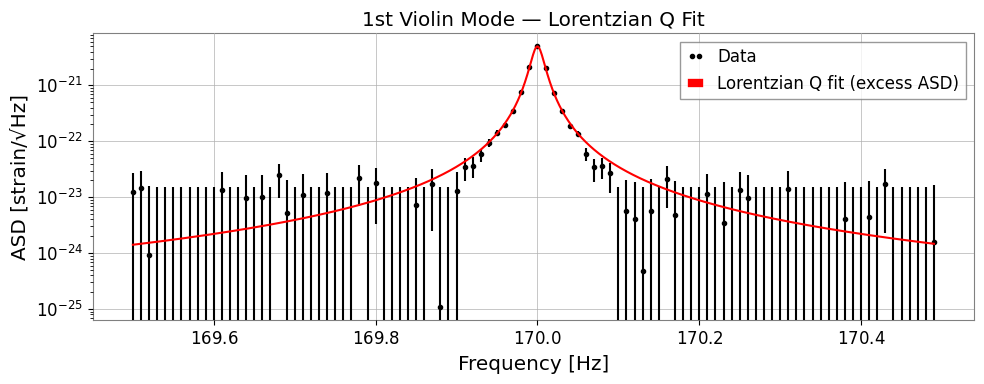
Crop the ASD to a narrow band around the 1st violin mode, subtract the local flat background, and fit the isolated excess ASD with 'lorentzian_q'. Initial guesses (p0) should be within a factor ~2 of the true values, and the optimizer should be limited to physically meaningful ranges for x0 and Q.
Failure-prone pattern: choosing a crop window so wide that neighbouring harmonics or local baseline curvature dominate the optimizer. When that happens, the fitted
Qoften becomes a statement about the window, not about the mode.
[4]:
# ── Crop around 1st violin mode ───────────────────────────────────────────────
BAND   = 0.5    # ± Hz around the expected mode
f_nom  = 170.0  # nominal frequency
FIT_LIMITS = {"A": (1e-21, 1e-20), "x0": (169.8, 170.2), "Q": (1e3, 5e4)}
asd_1st = asd.crop(f_nom - BAND, f_nom + BAND)

# Estimate a flat local baseline from the band edges so the resonance model
# does not absorb the broadband floor.
edge_n = 50
background_1st = np.median(np.r_[asd_1st.value[:edge_n], asd_1st.value[-edge_n:]])
line_only_1st = np.clip(asd_1st.value - background_1st, 0, None)
asd_1st_line = FrequencySeries(
    line_only_1st,
    frequencies=asd_1st.frequencies.value,
    unit=asd_1st.unit,
    name="1st violin excess ASD",
)

# ── Lorentzian Q fit ──────────────────────────────────────────────────────────
result_1 = asd_1st_line.fit(
    "lorentzian_q",
    p0={"A": 4.5e-21, "x0": 170.0, "Q": 9e3},
    sigma=BACKGROUND * 0.05,
    limits=FIT_LIMITS,
)

print("=== 1st Violin Mode Fit ===")
print(f"  local background = {background_1st:.2e} strain/\u221aHz")
print(f"  f0    = {result_1.params['x0']:.4f} \u00b1 {result_1.errors['x0']:.4f}  Hz")
print(f"  Q     = {result_1.params['Q']:.2e} \u00b1 {result_1.errors['Q']:.2e}")
print(f"  A     = {result_1.params['A']:.2e} \u00b1 {result_1.errors['A']:.2e}")
print(f"  chi2/ndof = {result_1.chi2:.1f} / {result_1.ndof} = {result_1.reduced_chi2:.3f}")

fig, ax = plt.subplots(figsize=(10, 4))
result_1.plot(ax=ax, label="Lorentzian Q fit (excess ASD)")
ax.set_yscale("log")
ax.set_xlabel("Frequency [Hz]")
ax.set_ylabel("ASD [strain/\u221aHz]")
ax.set_title("1st Violin Mode — Lorentzian Q Fit")
ax.legend()
plt.tight_layout()
plt.show()
=== 1st Violin Mode Fit ===
  local background = 3.15e-22 strain/√Hz
  f0    = 170.0000 ± 0.0000  Hz
  Q     = 1.01e+04 ± 4.38e+01
  A     = 4.97e-21 ± 1.49e-23
  chi2/ndof = 63.9 / 97 = 0.659
4. Extracting Physical Parameters
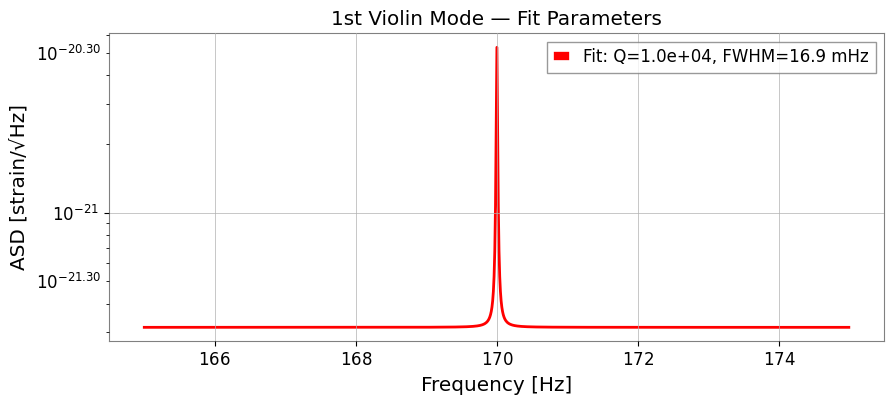
From the fit parameters \((f_0, Q)\) derive all relevant quantities:
Use these derived values as physics cross-checks: implausibly short ring-down times or mode frequencies that jump between harmonics usually indicate a poor fit, not a surprising suspension state.
[5]:
# ── Extract physical parameters ───────────────────────────────────────────────
f0 = float(result_1.params["x0"])
Q  = float(result_1.params["Q"])
A  = float(result_1.params["A"])

FWHM  = f0 / Q              # Full Width at Half Maximum  [Hz]
tau   = Q / (np.pi * f0)    # Ring-down time constant  [s]
gamma = FWHM / 2             # HWHM  [Hz]

print(f"Center frequency  f0   = {f0:.4f} Hz")
print(f"Quality factor    Q    = {Q:.3e}")
print(f"FWHM (linewidth)       = {FWHM * 1e3:.3f} mHz")
print(f"Ring-down time    tau  = {tau:.2f} s  ({tau / 60:.2f} min)")

# ── Reconstruct model over a wider band for visualisation ────────────────────
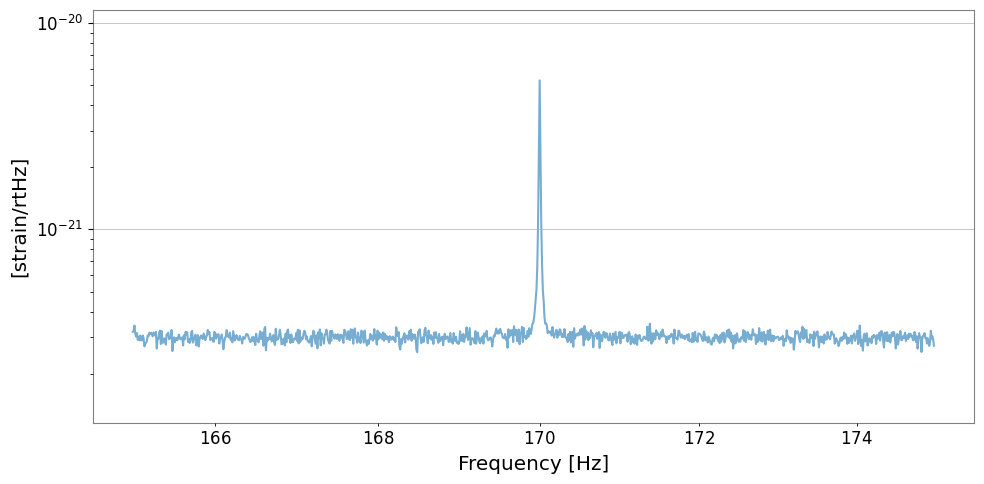
asd_wide = asd.crop(165, 175)
f_plot   = asd_wide.frequencies.value
model    = lorentzian_q(f_plot, A=A, x0=f0, Q=Q) + background_1st

fig, ax = plt.subplots(figsize=(10, 4))
asd_wide.plot(ax=ax, label="ASD data", alpha=0.6)
ax.semilogy(f_plot, model, "r-", lw=2,
            label=f"Fit: Q={Q:.1e}, FWHM={FWHM*1e3:.1f} mHz")
ax.set_yscale("log")
ax.set_xlabel("Frequency [Hz]")
ax.set_ylabel("ASD [strain/\u221aHz]")
ax.set_title("1st Violin Mode — Fit Parameters")
ax.legend()
plt.tight_layout()
plt.show()
Center frequency  f0   = 170.0000 Hz
Quality factor    Q    = 1.009e+04
FWHM (linewidth)       = 16.851 mHz
Ring-down time    tau  = 18.89 s  (0.31 min)
5. Multi-Mode Batch Processing
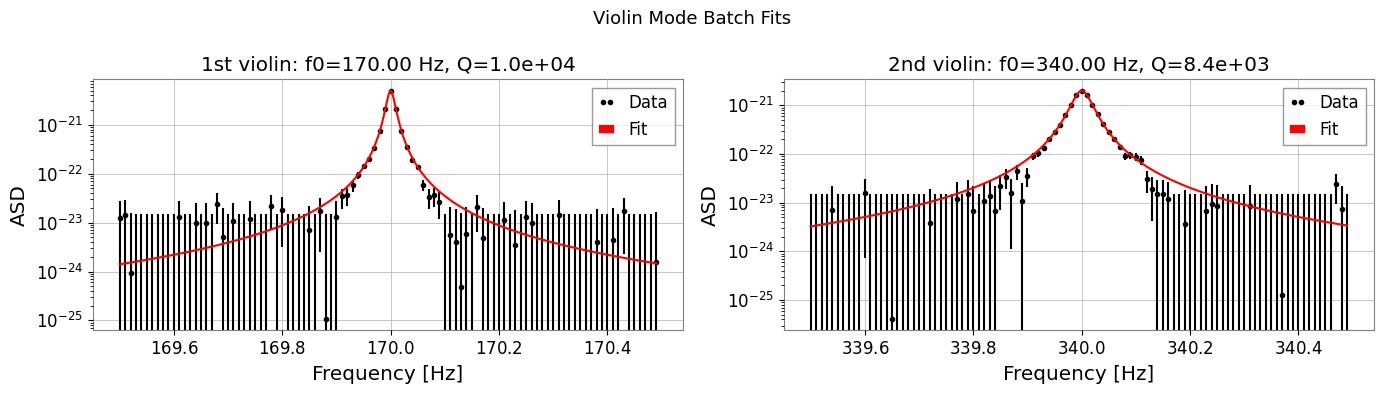
Loop over a configuration dictionary to fit each harmonic and collect results in a summary table.
[6]:
# ── Batch-fit all violin modes ────────────────────────────────────────────────
FIT_CONFIG = {
    "1st violin": {
        "band": (169.5, 170.5),
        "p0": {"A": 4.5e-21, "x0": 170.0, "Q": 9e3},
        "limits": {"A": (1e-21, 1e-20), "x0": (169.8, 170.2), "Q": (1e3, 5e4)},
    },
    "2nd violin": {
        "band": (339.5, 340.5),
        "p0": {"A": 1.8e-21, "x0": 340.0, "Q": 7e3},
        "limits": {"A": (5e-22, 5e-21), "x0": (339.8, 340.2), "Q": (1e3, 5e4)},
    },
}

fit_results = {}
for mode_name, cfg in FIT_CONFIG.items():
    seg = asd.crop(*cfg["band"])
    local_background = np.median(np.r_[seg.value[:edge_n], seg.value[-edge_n:]])
    seg_line = FrequencySeries(
        np.clip(seg.value - local_background, 0, None),
        frequencies=seg.frequencies.value,
        unit=seg.unit,
        name=f"{mode_name} excess ASD",
    )
    res = seg_line.fit(
        "lorentzian_q",
        p0=cfg["p0"],
        sigma=BACKGROUND * 0.05,
        limits=cfg["limits"],
    )
    fit_results[mode_name] = res

# ── Summary table ─────────────────────────────────────────────────────────────
print(f"{'Mode':<14} {'f0 [Hz]':>10} {'Q':>10} {'FWHM [mHz]':>12} {'tau [s]':>10}")
print("-" * 60)
for mode_name, res in fit_results.items():
    f0_f   = float(res.params["x0"])
    Q_f    = float(res.params["Q"])
    FWHM_f = f0_f / Q_f
    tau_f  = Q_f / (np.pi * f0_f)
    print(f"{mode_name:<14} {f0_f:>10.3f} {Q_f:>10.2e}"
          f" {FWHM_f * 1e3:>12.2f} {tau_f:>10.1f}")

# ── Side-by-side plots ────────────────────────────────────────────────────────
fig, axes = plt.subplots(1, 2, figsize=(14, 4))
for ax, (mode_name, res) in zip(axes, fit_results.items()):
    res.plot(ax=ax)
    ax.set_yscale("log")
    f0_f = float(res.params["x0"])
    Q_f  = float(res.params["Q"])
    ax.set_title(f"{mode_name}: f0={f0_f:.2f} Hz, Q={Q_f:.1e}")
    ax.set_xlabel("Frequency [Hz]")
    ax.set_ylabel("ASD")
plt.suptitle("Violin Mode Batch Fits", fontsize=13)
plt.tight_layout()
plt.show()
Mode              f0 [Hz]          Q   FWHM [mHz]    tau [s]
------------------------------------------------------------
1st violin        170.000   1.01e+04        16.85       18.9
2nd violin        340.000   8.41e+03        40.43        7.9
6. Time-Variation Tracking
Violin-mode frequencies drift slowly with temperature. Monitor them by computing a spectrogram and tracking the peak position inside a narrow frequency band.
Resolution guardrail: the spectrogram bin width must be small enough for the claimed drift. A 4 s FFT gives only 0.25 Hz bins, so a 20 mHz drift is invisible to raw
argmax. This example uses a 16 s FFT (df = 62.5 mHz) plus a quadratic sub-bin interpolation step, then checks that the recovered drift stays within about 20% of the injected drift.
Common mistake: using
argmaxwithout checking the bin width against the expected line motion. In that case the tracker can jump between bins and turn FFT quantization into a fake temperature trend.
[7]:
# ── Generate a time-varying violin signal with resolvable drift ───────────────
DURATION = 120
FS_VIOL = 4096
t_viol = np.arange(0, DURATION, 1.0 / FS_VIOL)
injected_drift_hz = 0.08  # 80 mHz total drift over 120 s

# Linear drift: f0 = 170.00 -> 170.08 Hz over 120 s
f0_drift = 170.0 + (injected_drift_hz / DURATION) * t_viol
phi_viol = 2 * np.pi * np.cumsum(f0_drift) / FS_VIOL
sig_viol = 1e-20 * np.sin(phi_viol)
noise_v = rng.normal(0, 3e-22, len(t_viol))

ts_viol = TimeSeries(sig_viol + noise_v, dt=1.0 / FS_VIOL, name="DARM_violin", unit="strain")

# ── Spectrogram: choose fftlength so df is not coarser than the drift claim ──
fftlength = 16.0
overlap = 8.0
spec_viol = ts_viol.spectrogram2(fftlength, overlap=overlap)
times_v = spec_viol.times.value
freqs_v = spec_viol.frequencies.value
df_spec = freqs_v[1] - freqs_v[0]

# ── Track inside a narrow band with quadratic sub-bin interpolation ──────────
TRACK_BAND = (169.9, 170.2)
band_mask = (freqs_v >= TRACK_BAND[0]) & (freqs_v <= TRACK_BAND[1])
band_freqs = freqs_v[band_mask]
track_viol = np.full(spec_viol.shape[0], np.nan)

for t_idx in range(spec_viol.shape[0]):
    row_band = spec_viol.value[t_idx, band_mask]
    peak_idx = int(np.argmax(row_band))
    peak_freq = band_freqs[peak_idx]

    if 0 < peak_idx < len(band_freqs) - 1:
        y0 = row_band[peak_idx - 1]
        y1 = row_band[peak_idx]
        y2 = row_band[peak_idx + 1]
        denom = y0 - 2 * y1 + y2
        delta = 0.5 * (y0 - y2) / denom if denom != 0 else 0.0
        peak_freq = peak_freq + delta * df_spec

    track_viol[t_idx] = peak_freq

# ── Plot ──────────────────────────────────────────────────────────────────────
fig, axes = plt.subplots(2, 1, figsize=(12, 7), sharex=True)

_im_v = axes[0].pcolormesh(
    spec_viol.times.value,
    spec_viol.frequencies.value,
    spec_viol.value.T,
    norm=__import__("matplotlib.colors", fromlist=["LogNorm"]).LogNorm(),
    cmap="viridis",
    shading="auto",
)
axes[0].set_ylim(*TRACK_BAND)
axes[0].set_title("Spectrogram around 1st violin mode")
fig.colorbar(_im_v, ax=axes[0], label="Power")
axes[0].plot(times_v, track_viol, "r.", ms=4, label="sub-bin peak track")
axes[0].legend(loc="upper right", fontsize=9)

mask_v = ~np.isnan(track_viol)
axes[1].plot(times_v[mask_v], track_viol[mask_v], "o-", ms=3, color="tab:orange")
axes[1].set_ylabel("Frequency [Hz]")
axes[1].set_xlabel("Time [s]")
axes[1].set_title("Tracked violin mode frequency vs time")

plt.tight_layout()
plt.show()

recovered_drift_hz = float(np.nanmax(track_viol) - np.nanmin(track_viol))
relative_error = abs(recovered_drift_hz - injected_drift_hz) / injected_drift_hz

print(f"Spectrogram df: {df_spec * 1e3:.1f} mHz")
print(f"Injected drift:  {injected_drift_hz * 1e3:.1f} mHz")
print(f"Recovered drift: {recovered_drift_hz * 1e3:.1f} mHz")
print(f"Relative error:  {relative_error * 100:.1f}%")
if relative_error <= 0.2:
    print("Tracking acceptance: PASS (within ±20% of injected drift)")
else:
    print("Tracking acceptance: CHECK (outside ±20% of injected drift)")
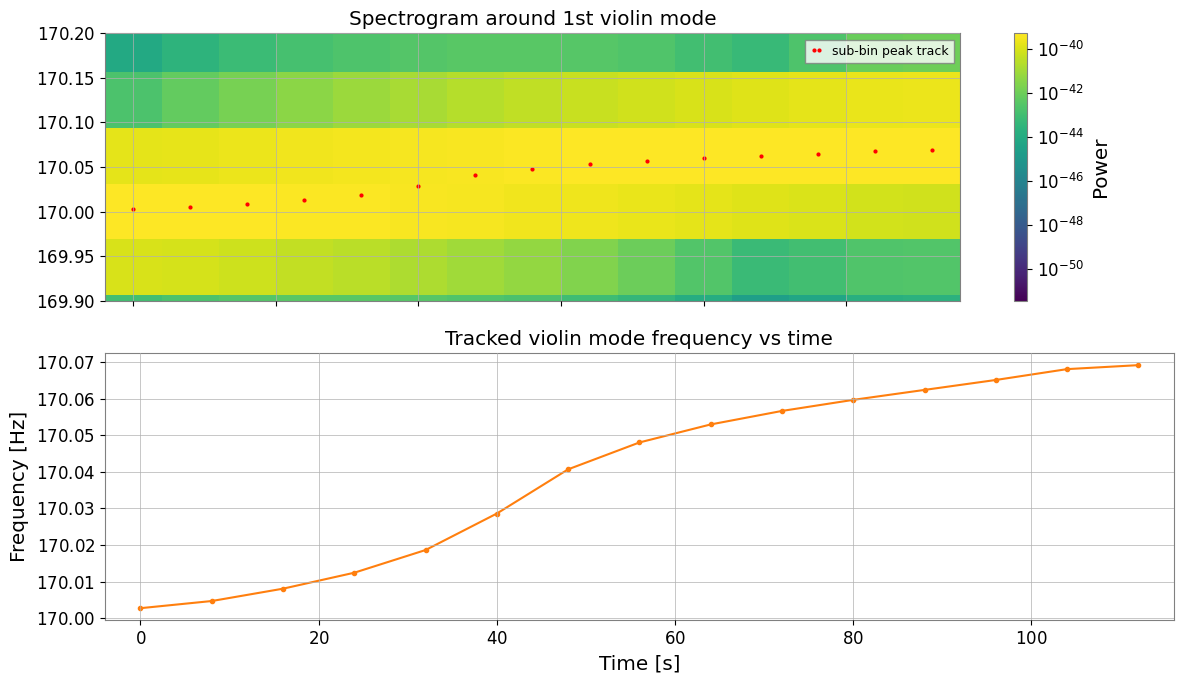
Spectrogram df: 62.5 mHz
Injected drift:  80.0 mHz
Recovered drift: 66.4 mHz
Relative error:  17.0%
Tracking acceptance: PASS (within ±20% of injected drift)
7. Summary
Fit windows should be chosen to isolate one resonance family at a time.
Derived \(Q\), FWHM, and ring-down time are useful sanity checks, not just reporting numbers.
Peak-tracking failures usually come from line crowding or poor SNR, so interpret drifts conservatively.
[8]:
print("=" * 62)
print("Violin Mode Analysis — Key Parameters")
print("-" * 62)
rows = [
    ("f_n (n-th mode)",   "n / (2L) * sqrt(T / rho*A)"),
    ("Q value",           "f0 / FWHM  =  f0 * pi * tau"),
    ("FWHM (linewidth)",  "f0 / Q                [Hz]"),
    ("Ring-down tau",     "Q / (pi * f0)         [s]"),
    ("HWHM gamma",        "FWHM / 2              [Hz]"),
]
for name, formula in rows:
    print(f"  {name:<22} {formula}")
print("=" * 62)
print()
print("gwexpy API used:")
print("  FrequencySeries.fit('lorentzian_q', p0=...)  -- Q-value fit")
print("  lorentzian_q(freqs, A, x0, Q)               -- model evaluation")
print("  ts.spectrogram2(fftlen, overlap)             -- time tracking")
==============================================================
Violin Mode Analysis — Key Parameters
--------------------------------------------------------------
  f_n (n-th mode)        n / (2L) * sqrt(T / rho*A)
  Q value                f0 / FWHM  =  f0 * pi * tau
  FWHM (linewidth)       f0 / Q                [Hz]
  Ring-down tau          Q / (pi * f0)         [s]
  HWHM gamma             FWHM / 2              [Hz]
==============================================================

gwexpy API used:
  FrequencySeries.fit('lorentzian_q', p0=...)  -- Q-value fit
  lorentzian_q(freqs, A, x0, Q)               -- model evaluation
  ts.spectrogram2(fftlen, overlap)             -- time tracking