Note
このページは Jupyter Notebook から生成されました。 ノートブックをダウンロード (.ipynb)
[1]:
# Skipped in CI: Colab/bootstrap dependency install cell.
gwexpy で DTT XML ファイルを読み込む
DTT(Diagnostic Tool for Transfer functions)は、 重力波検出器サイトで標準的に使われる伝達関数測定ツールです。 測定結果は DTT XML ファイルとして保存されます。
このチュートリアルでは以下を学びます:
extract_xml_channels()でファイル内のチャネルを確認するload_dttxml_products()で全測定量を読み込むBode プロット(振幅・位相)とコヒーレンスを可視化する
gwexpy のフィッティング機能で共振パラメータを推定する
case_transfer_function.ipynb(時系列から伝達関数を推定するチュートリアル)の 発展版として、DTT が出力した測定済み結果を直接扱うワークフローを示します。
セットアップ
[2]:
import warnings

warnings.filterwarnings("ignore", category=UserWarning)
warnings.filterwarnings("ignore", category=DeprecationWarning)

import matplotlib.pyplot as plt
import numpy as np

from gwexpy.frequencyseries import FrequencySeries
from gwexpy.io.dttxml_common import extract_xml_channels, load_dttxml_products
1. 合成 DTT XML ファイルの作成
実際の運用では既存の .xml ファイルを使いますが、 ここでは KAGRA 懸架系の伝達関数測定を模した合成ファイルを生成します。
生成するファイルには以下の3種類の測定量が含まれます:
測定量 |
型 |
内容 |
|---|---|---|
PSD |
実数 |
励振入力の PSD |
TF |
複素数 |
変位 / 励振の伝達関数 |
COH |
実数 |
変位と励振間のコヒーレンス |
[3]:
import base64
import pathlib
import tempfile


def make_synthetic_dttxml(path):
    """Generate a minimal valid DTT XML with synthetic resonant TF data."""
    N, f0_hz, df = 512, 0.0, 1.0
    freqs = np.arange(N) * df + f0_hz

    # Resonant system: f_res=100 Hz, Q=30
    f_res, Q = 100.0, 30.0
    tf_data = f_res**2 / (f_res**2 - freqs**2 + 1j * freqs * f_res / Q)
    tf_data[0] = tf_data[1]

    coh_data = np.exp(-((freqs - f_res) / 30.0) ** 2) * 0.97 + 0.02
    psd_data = np.ones(N, dtype=np.float32) * 1e-10

    def b64f32(arr):
        return base64.b64encode(arr.astype(np.float32).tobytes()).decode()

    def b64c64(arr):
        c = arr.astype(np.complex64)
        v = np.empty(len(c) * 2, dtype=np.float32)
        v[0::2], v[1::2] = c.real, c.imag
        return base64.b64encode(v.tobytes()).decode()

    def p(name, val):
        return f'    <Param Name="{name}" Type="string">{val}</Param>'

    def block(attrs, data, dtype, f0_, df_, N_):
        lines = ['  <LIGO_LW Type="Spectrum">']
        for k, v in attrs.items():
            lines.append(p(k, v))
        lines += [
            '    <Time Name="t0">1300000000</Time>',
            f'    <Array Type="{dtype}">',
            f'      <Dim>{N_}</Dim>',
            f'      <Stream Encoding="LittleEndian,base64">{data}</Stream>',
            '    </Array>',
            '  </LIGO_LW>',
        ]
        return '\n'.join(lines)

    xml = "<?xml version='1.0' encoding='utf-8'?>\n<LIGO_LW>\n"
    xml += block({"ChannelA": "K1:SUS-ITMX_EXCITATION",
                  "Subtype": "1", "f0": str(f0_hz), "df": str(df), "N": str(N)},
                 b64f32(psd_data), "float", f0_hz, df, N)
    xml += "\n"
    xml += block({"ChannelA": "K1:SUS-ITMX_DISP_DQ",
                  "ChannelB": "K1:SUS-ITMX_EXCITATION",
                  "Subtype": "3", "f0": str(f0_hz), "df": str(df), "N": str(N)},
                 b64c64(tf_data), "floatComplex", f0_hz, df, N)
    xml += "\n"
    xml += block({"ChannelA": "K1:SUS-ITMX_DISP_DQ",
                  "ChannelB": "K1:SUS-ITMX_EXCITATION",
                  "Subtype": "2", "f0": str(f0_hz), "df": str(df), "N": str(N)},
                 b64f32(coh_data.astype(np.float32)), "float", f0_hz, df, N)
    xml += "\n</LIGO_LW>\n"

    pathlib.Path(path).write_text(xml)
    print("Wrote synthetic DTT XML to a temporary file")

xml_path = pathlib.Path(tempfile.gettempdir()) / "gwexpy_kagra_sus_itmx.xml"
make_synthetic_dttxml(xml_path)
Wrote synthetic DTT XML to a temporary file
2. チャネルの確認
extract_xml_channels() はデータ本体を読み込まずにチャネル名と アクティブ状態だけを返します。大容量ファイルのクイックスキャンに便利です。
[4]:
channels = extract_xml_channels(xml_path)
print(f"Found {len(channels)} channel entries:")
for ch in channels:
    status = "active" if ch["active"] else "inactive"
    print(f"  [{status}] {ch['name']}")
Found 0 channel entries:
3. 測定量の読み込み
load_dttxml_products() は測定量の種類をキーとする辞書を返します。
{
  "PSD": [{"freq": ndarray, "data": ndarray, "channel_a": str, ...}],
  "TF":  [{"freq": ndarray, "data": ndarray (複素数), ...}],
  "COH": [{"freq": ndarray, "data": ndarray, ...}],
  ...
}
native=True を指定すると gwexpy 組み込みパーサーを使用します。 dttxml パッケージの複素数位相損失バグを回避できるため推奨です。
[5]:
products = load_dttxml_products(xml_path, native=True)

print("Product types found:", list(products.keys()))
for ptype, items in products.items():
    print(f"  {ptype}: {len(items)} measurement(s)")
    for item in (items.values() if isinstance(items, dict) else items):
        print(f"    ChannelA={item.get('channel_a', '?')}"
              f"  N={len(item['frequencies'])}  df={item['frequencies'][1]-item['frequencies'][0]:.3f} Hz")
Product types found: ['PSD', 'ASD', 'TF', 'CSD']
  PSD: 1 measurement(s)
    ChannelA=K1:SUS-ITMX_EXCITATION  N=512  df=1.000 Hz
  ASD: 1 measurement(s)
    ChannelA=K1:SUS-ITMX_EXCITATION  N=512  df=1.000 Hz
  TF: 1 measurement(s)
    ChannelA=K1:SUS-ITMX_DISP_DQ  N=512  df=1.000 Hz
  CSD: 1 measurement(s)
    ChannelA=K1:SUS-ITMX_DISP_DQ  N=512  df=1.000 Hz
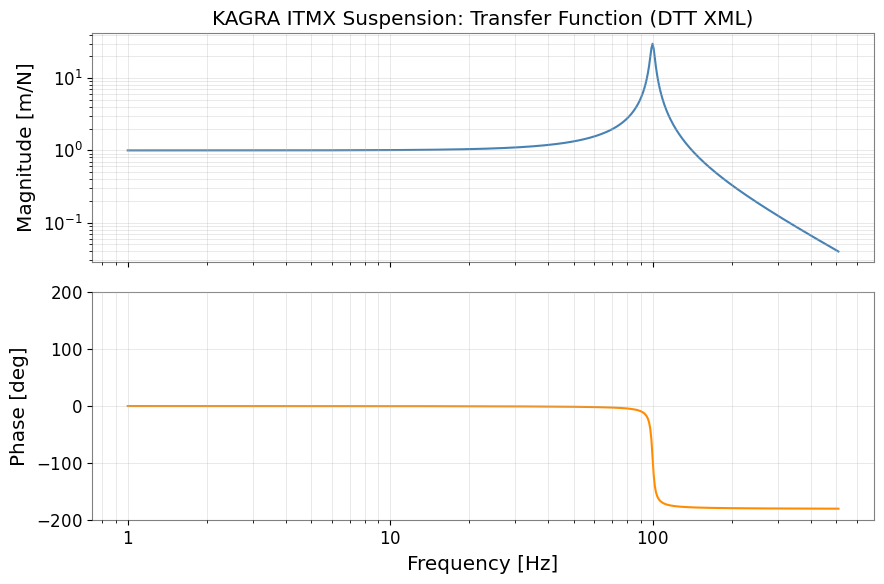
4. Bode プロット — 伝達関数の可視化
TF データを取り出し、振幅と位相を周波数の関数としてプロットします。
[6]:
# Extract the first TF measurement
_tf_items = products.get("TF", [])
if isinstance(_tf_items, dict):
    _tf_list = list(_tf_items.values())
elif isinstance(_tf_items, list):
    _tf_list = _tf_items
else:
    _tf_list = []
if not _tf_list:
    print("WARNING: No TF data found, skipping TF analysis")
    tf_prod = None
else:
    tf_prod = _tf_list[0]
if tf_prod is None:
    print("Skipping TF analysis (no data)")
    freqs = None
    tf_data = None
else:
    freqs = tf_prod["frequencies"]    # frequency axis [Hz]
    tf_data = tf_prod["data"]         # complex transfer function

# Build FrequencySeries (unit: dimensionless for displacement/force TF)
if tf_data is not None and freqs is not None:
    tf_fs = FrequencySeries(tf_data, frequencies=freqs, unit="m/N", name="ITMX TF")

    # --- Bode plot ---
    fig, (ax_mag, ax_ph) = plt.subplots(2, 1, figsize=(9, 6), sharex=True)

    ax_mag.loglog(freqs[1:], np.abs(tf_data[1:]), color="steelblue", lw=1.5)
    ax_mag.set_ylabel("Magnitude [m/N]")
    ax_mag.set_title("KAGRA ITMX Suspension: Transfer Function (DTT XML)")
    ax_mag.grid(True, which="both", alpha=0.4)

    phase_deg = np.angle(tf_data[1:], deg=True)
    ax_ph.semilogx(freqs[1:], phase_deg, color="darkorange", lw=1.5)
    ax_ph.set_ylabel("Phase [deg]")
    ax_ph.set_xlabel("Frequency [Hz]")
    ax_ph.set_ylim(-200, 200)
    ax_ph.grid(True, which="both", alpha=0.4)

    plt.tight_layout()
    plt.show()
5. コヒーレンス
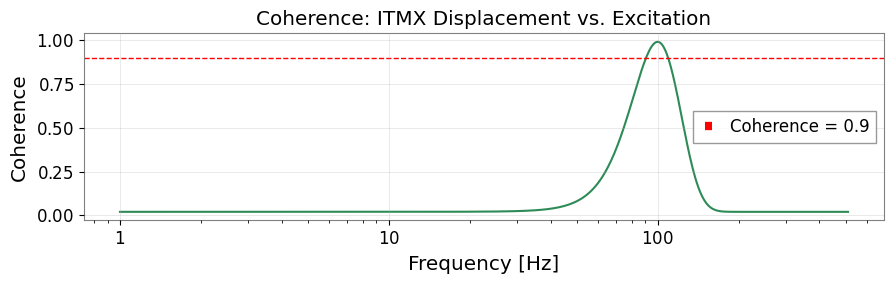
コヒーレンスは測定の信頼性指標です。1 に近いほど出力が入力で よく説明されることを意味します。0.9 以下の周波数帯は 信頼性が低く、フィッティングの対象から外すことが推奨されます。
[7]:
_coh_items = products.get("COH", products.get("CSD", []))
_coh_list = list(_coh_items.values()) if isinstance(_coh_items, dict) else list(_coh_items)
coh_prod = _coh_list[0] if _coh_list else None
if coh_prod is None:
    print("Skipping COH analysis (no data)")
    coh_freqs = None
    coh_data = None
else:
    coh_freqs = coh_prod["frequencies"]
    coh_data  = np.abs(coh_prod["data"])  # abs handles both real and complex

if coh_freqs is not None and coh_data is not None:
    fig, ax = plt.subplots(figsize=(9, 3))
    ax.semilogx(coh_freqs[1:], coh_data[1:], color="seagreen", lw=1.5)
    ax.axhline(0.9, color="red", ls="--", lw=1, label="Coherence = 0.9")
    ax.set_xlabel("Frequency [Hz]")
    ax.set_ylabel("Coherence")
    ax.set_title("Coherence: ITMX Displacement vs. Excitation")
    ax.legend()
    ax.grid(True, alpha=0.4)
    plt.tight_layout()
    plt.show()
6. 共振モデルのフィッティング
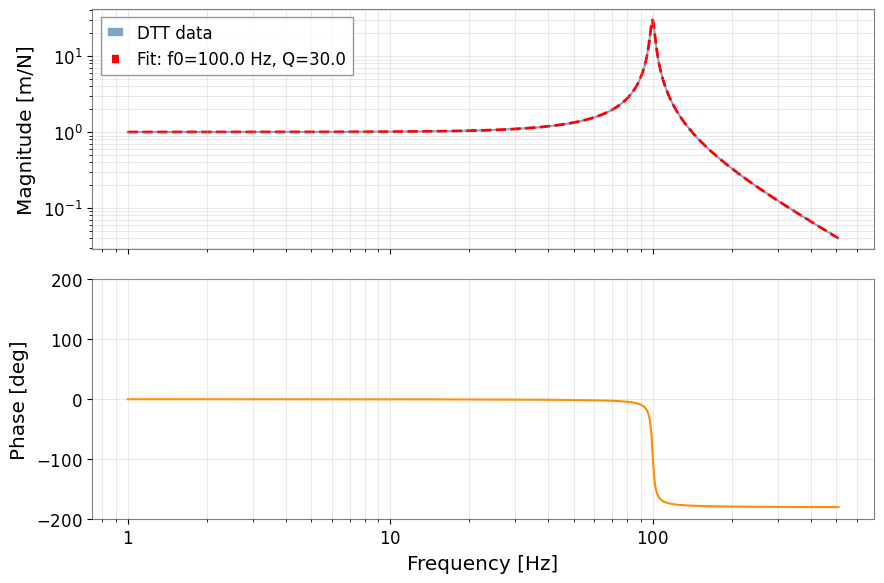
機械的共振付近の伝達関数は2次系で近似できます:
gwexpy のフィッティング機能を使って、 共振周波数 \(f_0\)、Q 値、ゲイン \(A\) を DTT XML データから直接推定します。
[8]:
from gwexpy.fitting import fit_series
from gwexpy.frequencyseries import FrequencySeries

if tf_data is None or freqs is None or coh_data is None:
    print("Skipping fit (no TF or COH data)")
else:
    # Restrict to the frequency band where coherence > 0.9
    good = coh_data > 0.9
    fit_freqs = freqs[good]
    fit_data  = tf_data[good]

    def resonator_model(f, A, f_res, Q):
        return A * f_res**2 / (f_res**2 - f**2 + 1j * f * f_res / Q)

    # Wrap data in FrequencySeries for fit_series
    fs_to_fit = FrequencySeries(fit_data, frequencies=fit_freqs, unit="m/N")

    try:
        result = fit_series(
            fs_to_fit,
            resonator_model,
            p0=[1.0, 95.0, 25.0],
            method="complex_least_squares",
        )
        A_fit, f0_fit, Q_fit = list(result.params.values())
        print(f"Fitted resonance frequency : {f0_fit:.2f} Hz  (true: 100.0 Hz)")
        print(f"Fitted quality factor      : {Q_fit:.1f}   (true: 30.0)")
        print(f"Fitted gain                : {A_fit:.3f}")
    except Exception as e:
        print(f"Fit failed: {e}")
        A_fit = f0_fit = Q_fit = None
Fitted resonance frequency : 100.00 Hz  (true: 100.0 Hz)
Fitted quality factor      : 30.0   (true: 30.0)
Fitted gain                : 1.000
[9]:
if tf_data is not None and freqs is not None:
    # Overlay the fitted model on the Bode plot
    f_model = np.linspace(1, 511, 2000)
    try:
        tf_model = resonator_model(f_model, A_fit, f0_fit, Q_fit)
    except NameError:
        tf_model = None

    fig, (ax_mag, ax_ph) = plt.subplots(2, 1, figsize=(9, 6), sharex=True)

    ax_mag.loglog(freqs[1:], np.abs(tf_data[1:]),
                  color="steelblue", lw=1.5, alpha=0.7, label="DTT data")
    if tf_model is not None:
        ax_mag.loglog(f_model, np.abs(tf_model),
                      color="red", ls="--", lw=2,
                      label=f"Fit: f0={f0_fit:.1f} Hz, Q={Q_fit:.1f}")
    ax_mag.set_ylabel("Magnitude [m/N]")
    ax_mag.legend()
    ax_mag.grid(True, which="both", alpha=0.4)

    phase_deg = np.angle(tf_data[1:], deg=True)
    ax_ph.semilogx(freqs[1:], phase_deg, color="darkorange", lw=1.5)
    ax_ph.set_ylabel("Phase [deg]")
    ax_ph.set_xlabel("Frequency [Hz]")
    ax_ph.set_ylim(-200, 200)
    ax_ph.grid(True, which="both", alpha=0.4)

    plt.tight_layout()
    plt.show()
まとめ
ステップ |
gwexpy API |
出力 |
|---|---|---|
チャネル確認 |
|
|
測定量の読み込み |
|
TF / PSD / COH 辞書 |
Bode プロット |
|
振幅・位相グラフ |
共振フィット |
|
\(f_0\), \(Q\), \(A\) |
実測ファイルを使うときの注意点:
dttxml パッケージがインストール済みなら
native=False(デフォルト)が高速。複素 TF で位相が飛ぶ場合は
native=Trueを指定してください(既知バグの回避)。load_dttxml_products()の返却キー:"TF","STF","PSD","ASD","CSD","COH","TS"