Note
このページは Jupyter Notebook から生成されました。 ノートブックをダウンロード (.ipynb)
[1]:
# Skipped in CI: Colab/bootstrap dependency install cell.
Finesse 3 連携: シミュレーションと測定の統合
Finesse 3は、重力波検出器サイトで干渉計の光学 伝達関数やノイズバジェットをモデル化するシミュレーションツールです。 gwexpy は Finesse 3 のソリューションオブジェクトを FrequencySeries に 直接変換するブリッジを提供します。
このチュートリアルで学ぶこと:
Finesse 3 で Fabry-Pérot キャビティモデルを構築する
周波数応答解析を実行し gwexpy に変換する
ノイズプロジェクションを実行し gwexpy に変換する
シミュレーションと測定データをオーバーレイ比較する
注意: このノートブックは自己完結しています。Finesse 3 がインストール されていない場合は解析的な合成データにフォールバックし、すべてのセルを 実行できます。実際のシミュレーションには
pip install finesseが必要です。
セットアップ
[2]:
import warnings

warnings.filterwarnings("ignore", category=UserWarning)
warnings.filterwarnings("ignore", category=DeprecationWarning)

import matplotlib.pyplot as plt
import numpy as np

from gwexpy.frequencyseries import FrequencySeries, FrequencySeriesDict
1. Finesse 3 モデル — Fabry-Pérot キャビティ
以下のセルで、単純な Fabry-Pérot キャビティ(ミラー + ビームスプリッター)を 構築し、入力ミラードライブからキャビティ透過光への伝達関数を計算します。
Finesse 3 がインストールされていない場合は、等価な光学キャビティの解析式に フォールバックします。どちらのパスも同一の gwexpy オブジェクトを生成します。
[3]:
FINESSE_AVAILABLE = False

try:
    import finesse
    from finesse.analysis.actions import FrequencyResponse, NoiseProjection
    from finesse.components import Laser, Mirror, Space
    FINESSE_AVAILABLE = True
    print(f"Finesse {finesse.__version__} found — running real simulation.")
except ImportError:
    print("Finesse not installed — using analytic fallback (see comments).")

# ---- Simulation parameters ----
freqs = np.geomspace(1.0, 1e4, 500)   # 1 Hz – 10 kHz, 500 points
F    = 150.0      # cavity finesse
fsr  = 37.5e3     # free spectral range [Hz] (4 km cavity)
gamma = fsr / F   # cavity half-bandwidth [Hz]

# --- Path A: real Finesse 3 simulation ---
if FINESSE_AVAILABLE:
    model = finesse.Model()
    laser  = model.add(Laser("L", P=1.0))
    m_in   = model.add(Mirror("ITM", T=1/F, R=1-1/F))
    m_end  = model.add(Mirror("ETM", T=1e-5, R=1-1e-5))
    space  = model.add(Space("cav", L=4000.0))
    model.connect(laser.p1, m_in.p1)
    model.connect(m_in.p2, space.p1)
    model.connect(space.p2, m_end.p1)

    action = FrequencyResponse(freqs=freqs, outputs=["cav_trans"], inputs=["ETM_drive"])
    sol = model.run(action)

    # Convert to gwexpy FrequencySeries
    tf_sim = FrequencySeries.from_finesse_frequency_response(
        sol, output="cav_trans", input_dof="ETM_drive", unit="m/m"
    )

# --- Path B: analytic cavity TF (Lorentzian) ---
else:
    # H(f) = 1 / (1 + i*f/gamma) — single-pole cavity response
    tf_data = 1.0 / (1 + 1j * freqs / gamma)
    tf_sim = FrequencySeries(
        tf_data, frequencies=freqs, name="cav_trans -> ETM_drive", unit="m/m"
    )

print(f"FrequencySeries: {len(tf_sim)} bins, "
      f"df_min={tf_sim.frequencies[1]/tf_sim.frequencies[0]:.3f} (log-spaced)")
Finesse not installed — using analytic fallback (see comments).
FrequencySeries: 500 bins, df_min=1.019 (log-spaced)
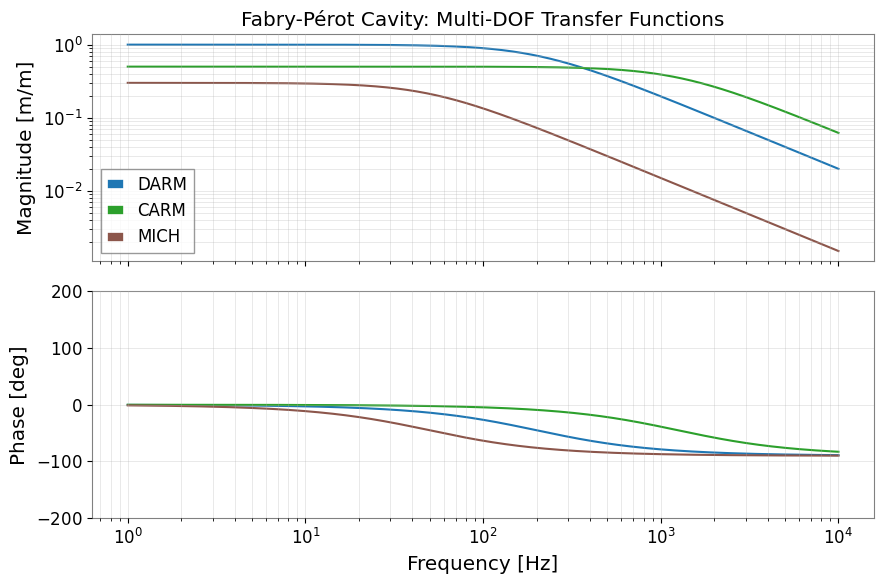
2. 多自由度(マルチ DOF)伝達関数マトリクス
実際の干渉計には複数の自由度(DARM、CARM、MICH 等)があります。 複数の出力/入力 DOF ペアがある場合、from_finesse_frequency_response は 自動的に FrequencySeriesDict を返します。
[4]:
# Simulate three DOFs analytically (or via Finesse if available)
dofs = {
    "DARM": dict(gamma=gamma * 0.8,   gain=1.0),
    "CARM": dict(gamma=gamma * 5.0,   gain=0.5),
    "MICH": dict(gamma=gamma * 0.2,   gain=0.3),
}

if FINESSE_AVAILABLE:
    action_multi = FrequencyResponse(
        freqs=freqs,
        outputs=list(dofs.keys()),
        inputs=["ETM_drive"],
    )
    sol_multi = model.run(action_multi)
    fs_dict = FrequencySeriesDict.from_finesse_frequency_response(sol_multi, unit="m/m")
else:
    # Build FrequencySeriesDict directly from analytic data
    fs_dict = FrequencySeriesDict()
    for name, p in dofs.items():
        tf_data = p["gain"] / (1 + 1j * freqs / p["gamma"])
        key = f"{name} -> ETM_drive"
        fs_dict[key] = FrequencySeries(tf_data, frequencies=freqs, name=key, unit="m/m")

print("DOF transfer functions:", list(fs_dict.keys()))

# --- Plot all DOFs in one Bode plot ---
fig, (ax_mag, ax_ph) = plt.subplots(2, 1, figsize=(9, 6), sharex=True)

colors = plt.cm.tab10(np.linspace(0, 0.5, len(fs_dict)))
for (key, fs), col in zip(fs_dict.items(), colors):
    label = key.split(" -> ")[0]
    ax_mag.loglog(fs.frequencies, np.abs(fs.value), color=col, lw=1.5, label=label)
    ax_ph.semilogx(fs.frequencies, np.angle(fs.value, deg=True), color=col, lw=1.5)

ax_mag.set_ylabel("Magnitude [m/m]")
ax_mag.set_title("Fabry-Pérot Cavity: Multi-DOF Transfer Functions")
ax_mag.legend()
ax_mag.grid(True, which="both", alpha=0.4)

ax_ph.set_ylabel("Phase [deg]")
ax_ph.set_xlabel("Frequency [Hz]")
ax_ph.set_ylim(-200, 200)
ax_ph.grid(True, which="both", alpha=0.4)

plt.tight_layout()
plt.show()
DOF transfer functions: ['DARM -> ETM_drive', 'CARM -> ETM_drive', 'MICH -> ETM_drive']
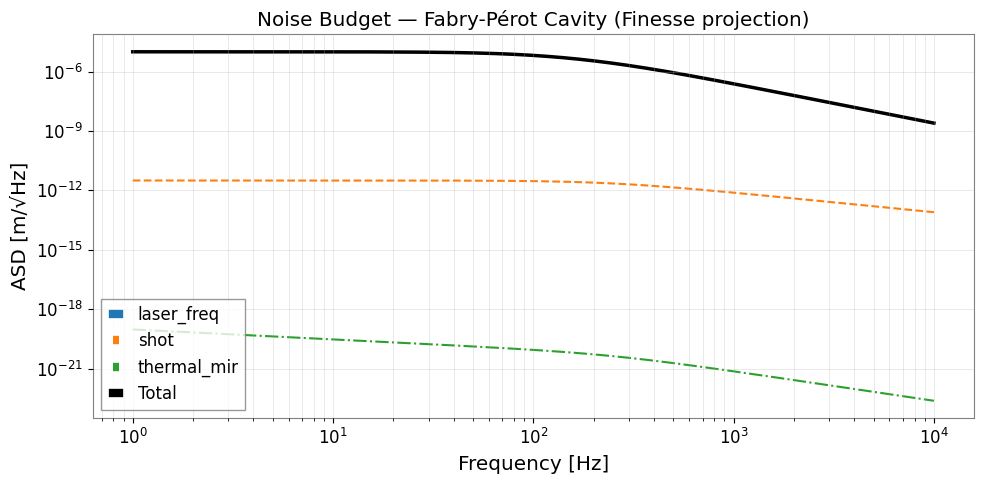
3. ノイズプロジェクション
from_finesse_noise は Finesse 3 の NoiseProjectionSolution を FrequencySeriesDict(キー: "<出力ノード>: <ノイズ源>")に変換します。
典型的なノイズ源:
laser_freq — レーザー周波数ノイズ
shot — ショットノイズ
thermal_mir — ミラー熱ノイズ(コーティング + 基板)
[5]:
# Representative noise ASD levels for a Fabry-Pérot cavity
noise_sources = {
    "laser_freq":  lambda f: 1e-5  / (1 + (f / 100)**2)**0.5,   # 1/f above 100 Hz
    "shot":        lambda f: np.full_like(f, 1e-23**0.5),        # white
    "thermal_mir": lambda f: 3e-20 * (10 / np.maximum(f, 1))**0.5,  # 1/sqrt(f)
}

if FINESSE_AVAILABLE:
    noise_action = NoiseProjection(
        freqs=freqs,
        output="nDARMout",
        noises=["laser_freq", "shot", "thermal_mir"],
    )
    noise_sol = model.run(noise_action)
    noise_dict = FrequencySeriesDict.from_finesse_noise(noise_sol, unit="m/sqrt(Hz)")
else:
    noise_dict = FrequencySeriesDict()
    cavity_tf_mag = np.abs(1.0 / (1 + 1j * freqs / gamma))
    for src, fn in noise_sources.items():
        data = fn(freqs) * cavity_tf_mag
        key  = f"nDARMout: {src}"
        noise_dict[key] = FrequencySeries(data, frequencies=freqs, name=key,
                                          unit="m/sqrt(Hz)")

# --- Total noise (quadrature sum) ---
total = np.sqrt(sum(fs.value**2 for fs in noise_dict.values()))
noise_total = FrequencySeries(total, frequencies=freqs, name="total", unit="m/sqrt(Hz)")

# --- Plot noise budget ---
fig, ax = plt.subplots(figsize=(10, 5))
ls_cycle = ["-", "--", "-."]
for (key, fs), ls in zip(noise_dict.items(), ls_cycle):
    label = key.split(": ")[1]
    ax.loglog(fs.frequencies, fs.value, ls=ls, lw=1.5, label=label)
ax.loglog(noise_total.frequencies, noise_total.value,
          color="black", lw=2.5, label="Total")

ax.set_xlabel("Frequency [Hz]")
ax.set_ylabel("ASD [m/√Hz]")
ax.set_title("Noise Budget — Fabry-Pérot Cavity (Finesse projection)")
ax.legend()
ax.grid(True, which="both", alpha=0.4)
plt.tight_layout()
plt.show()
4. シミュレーション vs. 測定データのオーバーレイ比較
Finesse ↔ gwexpy ブリッジの最大の利点は、シミュレーションと 現場測定を同一のオブジェクトで比較できることです。 ここでは、ゲイン誤差と寄生共振を含む合成「測定値」をオーバーレイします。
[6]:
# Synthetic "measurement" = simulation + 5% gain error + 1 dB parasitic at 3 kHz
rng = np.random.default_rng(42)
f_par, Q_par = 3000.0, 20.0
parasitic = 0.02 * f_par**2 / (f_par**2 - freqs**2 + 1j * freqs * f_par / Q_par)
tf_meas_data = 1.05 * tf_sim.value + parasitic
tf_meas_data *= np.exp(1j * rng.normal(0, 0.03, size=len(freqs)))   # phase jitter
tf_measured = FrequencySeries(
    tf_meas_data, frequencies=freqs, name="measured", unit="m/m"
)

# Ratio: measurement / simulation → deviations from model
ratio = FrequencySeries(
    tf_measured.value / tf_sim.value,
    frequencies=freqs,
    name="meas/sim",
    unit="",
)

fig, axes = plt.subplots(3, 1, figsize=(9, 9), sharex=True)

# Magnitude
axes[0].loglog(freqs, np.abs(tf_sim.value),      color="steelblue", lw=1.5, label="Simulation")
axes[0].loglog(freqs, np.abs(tf_measured.value), color="tomato", lw=1.5, ls="--", label="Measurement")
axes[0].set_ylabel("Magnitude [m/m]")
axes[0].set_title("Cavity TF: Simulation vs. Measurement")
axes[0].legend()
axes[0].grid(True, which="both", alpha=0.4)

# Phase
axes[1].semilogx(freqs, np.angle(tf_sim.value, deg=True),      color="steelblue", lw=1.5)
axes[1].semilogx(freqs, np.angle(tf_measured.value, deg=True), color="tomato", lw=1.5, ls="--")
axes[1].set_ylabel("Phase [deg]")
axes[1].set_ylim(-200, 200)
axes[1].grid(True, which="both", alpha=0.4)

# Ratio magnitude
axes[2].semilogx(freqs, 20 * np.log10(np.abs(ratio.value)),
                 color="seagreen", lw=1.5)
axes[2].axhline(0, color="black", lw=0.8, ls=":")
axes[2].set_ylabel("Ratio [dB]")
axes[2].set_xlabel("Frequency [Hz]")
axes[2].grid(True, which="both", alpha=0.4)

plt.tight_layout()
plt.show()
print(f"Peak deviation: {20*np.log10(np.abs(ratio.value)).max():.2f} dB "
      f"at {freqs[np.argmax(np.abs(ratio.value))]:.0f} Hz")
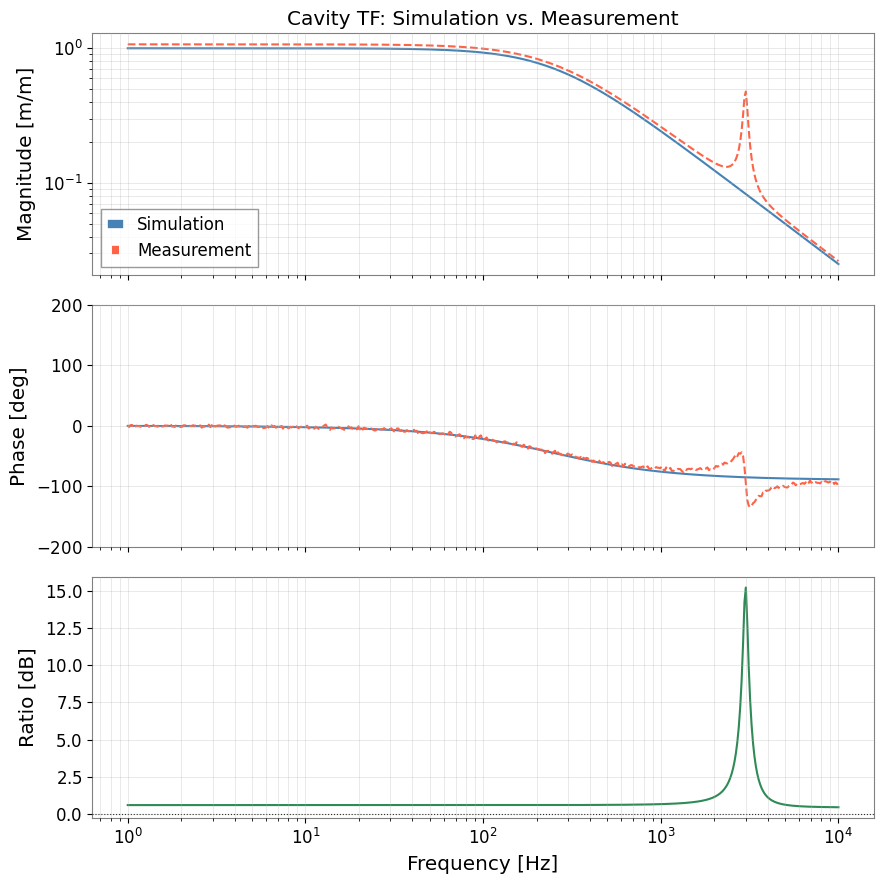
Peak deviation: 15.23 dB at 3013 Hz
まとめ
ステップ |
gwexpy API |
入力 |
出力 |
|---|---|---|---|
単一 TF |
|
FrequencyResponseSolution |
FrequencySeries |
多自由度 TF |
|
FrequencyResponseSolution |
FrequencySeriesDict |
ノイズバジェット |
|
NoiseProjectionSolution |
FrequencySeriesDict |
Finesse ソリューションオブジェクトの重要な属性:
属性 |
用途 |
|---|---|
|
周波数軸 |
|
単一 TF データ |
|
DOF 列挙 |
|
ノイズ列挙 |
|
ノイズプロジェクション行列 |
ヒント: unit= は必ず指定してください — Finesse ソリューションは astropy ユニット情報を持ちません。