
校正伝達関数と物理単位契約#
このチュートリアルでは、単位 count / m を持つ周波数依存の校正伝達関数 \(C(f) = Y(f) / X(f)\) を厳密に適用し、生のデジタルカウントを物理変位メートル \([\mathrm{m}]\) および差動アームひずみ \([1 / \sqrt{\mathrm{Hz}}]\) へ変換する手法を実証します。
科学的および計算上の目標#
物理入出力規約: 周波数応答 \(C(f)\) [count / m] を定義し、逆校正 \(X(f) = Y(f) / C(f)\) を適用して物理変位を復元します。
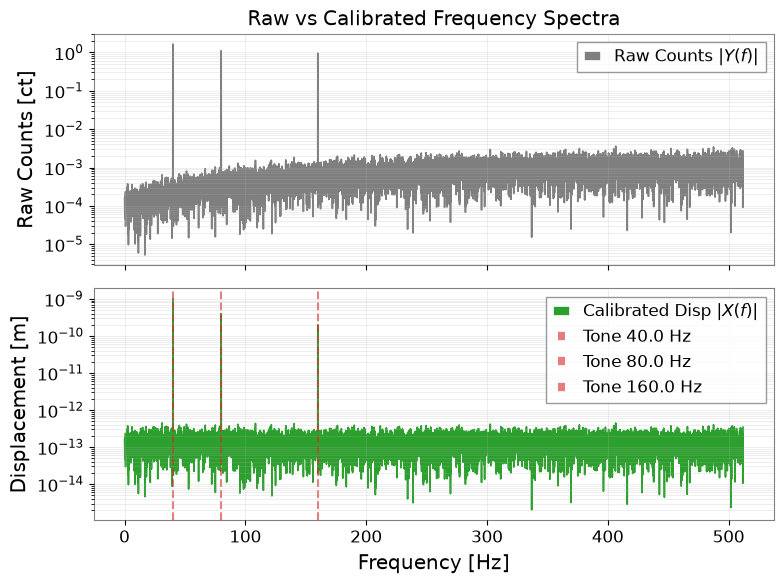
高調波トーン信号の復元: 3つの離散校正ライン(40 Hz, 80 Hz, 160 Hz)を注入し、振幅復元誤差 \(<2\%\) および位相整合性 \(<10^{-6}\) rad を確認します。
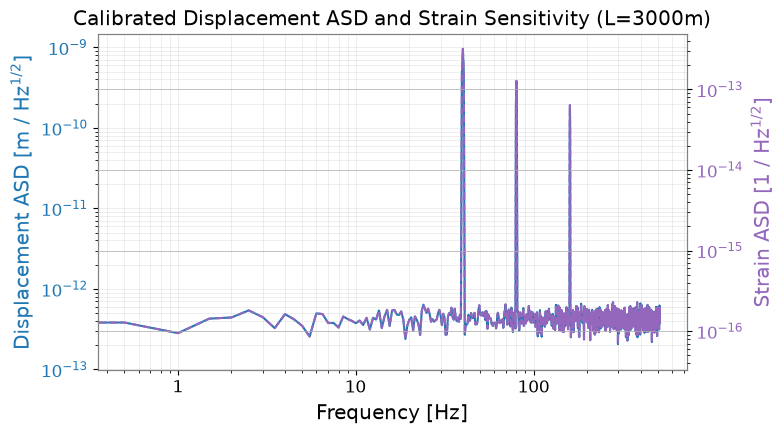
ASD・PSD 次元整合性: 変位 ASD の単位が \([\mathrm{m} / \sqrt{\mathrm{Hz}}]\)、PSD の単位が \([\mathrm{m}^2 / \mathrm{Hz}]\) であることを検証し、アームひずみ感度 \(h(f) = X(f) / L\)(\(L = 3000\,\mathrm{m}\))を算出します。
防御的検証: Astropy の
UnitConversionErrorによる逆方向変換の検出、周波数グリッド不一致の検出、およびDC特異点(ゼロ応答)の安全な除外を実証します。
環境のセットアップ#
import json
import os
import platform
import tempfile
from pathlib import Path

from IPython.display import display
import matplotlib.pyplot as plt
import numpy as np
import pandas as pd
from astropy import units as u
from astropy.units import UnitConversionError

import gwexpy
from gwexpy.frequencyseries import FrequencySeries
from gwexpy.timeseries import TimeSeries

output_dir = Path(os.environ.get("GWEXPY_DOCS_OUTPUT_DIR") or tempfile.mkdtemp(prefix="gwexpy-t6-"))
output_dir.mkdir(parents=True, exist_ok=True)
(output_dir / "figures").mkdir(exist_ok=True)
(output_dir / "tables").mkdir(exist_ok=True)
print(f"Output directory: {output_dir}")
Output directory: /tmp/gwexpy-t6-c1j7147b
1. Physical Signal and Calibration Model#
3本の校正用正弦波注入ラインと広帯域背景変位ノイズを含む物理変位信号 \(x_{\mathrm{phys}}(t)\) [m] をシミュレーションします。
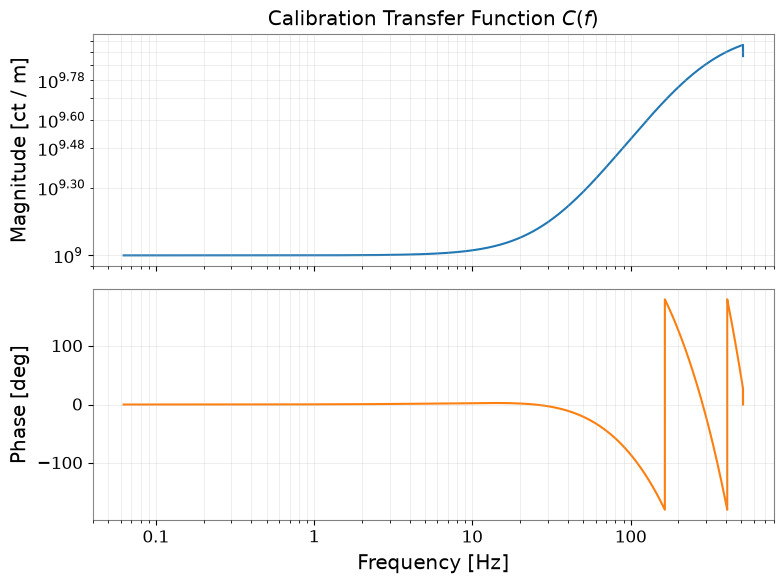
測定器の読み出し系は、DCゲイン \(G = 1.0 \times 10^9\,\mathrm{ct/m}\)、高周波ロールオフ極 \(f_p = 300\,\mathrm{Hz}\)、零点 \(f_z = 30\,\mathrm{Hz}\)、および固定パイプライン遅延 \(\tau = 4 / f_s\,\mathrm{s}\) を持つ周波数依存の伝達関数 \(C(f)\) [count / m] を導入します。
fs = 1024.0
dt = 1.0 / fs
duration = 16.0
n_samples = int(fs * duration)
t = np.arange(n_samples) * dt
df = 1.0 / duration
freqs = np.fft.rfftfreq(n_samples, d=dt)

tone_configs = [
    {"freq": 40.0, "amp": 1.0e-9},
    {"freq": 80.0, "amp": 0.4e-9},
    {"freq": 160.0, "amp": 0.2e-9},
]

# Physical displacement signal [m]
# 3 injected sinusoidal lines plus background noise
rng = np.random.default_rng(2026091606)
noise_disp = rng.normal(0, 1e-11, n_samples)
x_phys_vals = (
    1.0e-9 * np.sin(2 * np.pi * 40.0 * t) +
    0.4e-9 * np.sin(2 * np.pi * 80.0 * t) +
    0.2e-9 * np.sin(2 * np.pi * 160.0 * t) +
    noise_disp
)
ts_phys = TimeSeries(x_phys_vals, dt=dt * u.s, unit=u.m, name="PHYSICAL_DISPLACEMENT")

gain = 1.0e9 # ct / m
delay_s = 4.0 / fs
fp = 300.0 # Hz pole
fz = 30.0 # Hz zero

# Response: G * (1 + j f/fz) / (1 + j f/fp) * exp(-2pi j f tau)
C_vals = gain * ((1.0 + 1j * freqs / fz) / (1.0 + 1j * freqs / fp)) * np.exp(-2j * np.pi * freqs * delay_s)
# Ensure Hermitian symmetry for real-valued signal at DC and Nyquist
C_vals[0] = float(np.real(C_vals[0]))
C_vals[-1] = float(np.real(C_vals[-1]))

C_response = FrequencySeries(
    C_vals,
    df=df * u.Hz,
    unit=u.ct / u.m,
    name="CALIBRATION_RESPONSE"
)

# Simulate raw counts via frequency-domain filtering
rfft_phys = np.fft.rfft(x_phys_vals)
rfft_counts = rfft_phys * C_vals
counts_vals = np.fft.irfft(rfft_counts, n=n_samples)

ts_counts = TimeSeries(counts_vals, dt=dt * u.s, unit=u.ct, name="RAW_COUNTS")

print(f"Physical signal: {ts_phys.shape} samples, unit={ts_phys.unit}")
print(f"Raw counts: {ts_counts.shape} samples, unit={ts_counts.unit}")
print(f"Calibration response: {len(C_response)} bins, unit={C_response.unit}")
Physical signal: (16384,) samples, unit=m
Raw counts: (16384,) samples, unit=ct
Calibration response: 8193 bins, unit=ct / m
2. Calibration Recovery and Harmonic Line Verification#
生のカウント \(Y(f)\) から変位 \(X(f)\) を復元校正するために、複素応答で除算します: $\(X_{\mathrm{cal}}(f) = \frac{Y(f)}{C(f)}\)\( 次元の整合性より次が成り立ちます: \)\(\frac{\mathrm{ct}}{\mathrm{ct} / \mathrm{m}} = \mathrm{m}\)$
注入された3つのライン周波数において、振幅および位相の復元精度を検証します。
# Primary verification path: compute FFT directly from raw count TimeSeries
fft_phys_fs = ts_phys.fft()
fft_counts_fs = ts_counts.fft()

# Apply calibration division on FrequencySeries
calibrated_disp_fs = fft_counts_fs / C_response
calibrated_disp_fs.name = "CALIBRATED_DISPLACEMENT"

assert calibrated_disp_fs.unit.is_equivalent(u.m), f"Invalid unit: {calibrated_disp_fs.unit}"

calibrated_disp_vals = calibrated_disp_fs.value
fft_counts_vals = fft_counts_fs.value
fft_phys_vals = fft_phys_fs.value

# Evaluate recovery at the 3 injected tones
tone_records = []
for tc in tone_configs:
    f_target = tc["freq"]
    idx = int(round(f_target / df))
    actual_f = freqs[idx]

    # In GWexpy single-sided FFT, peak magnitude corresponds directly to tone amplitude
    est_amp = float(np.abs(calibrated_disp_fs.value[idx]))
    true_amp = tc["amp"]
    rel_amp_err = float(abs(est_amp - true_amp) / true_amp)

    # Phase recovery relative to original injected physical signal FFT
    phase_err = float(np.abs(np.angle(calibrated_disp_fs.value[idx] * np.conj(fft_phys_vals[idx]))))

    tone_records.append({
        "tone_hz": float(f_target),
        "true_amp_m": float(true_amp),
        "est_amp_m": float(est_amp),
        "rel_amp_err": float(rel_amp_err),
        "phase_err_rad": float(phase_err),
        "amplitude_error_rel": float(rel_amp_err),
        "phase_error_rad": float(phase_err),
        "status": "passed" if rel_amp_err < 0.02 and phase_err < 1e-6 else "failed"
    })

df_tones = pd.DataFrame(tone_records)
df_tones.to_csv(output_dir / "tables/calibrated_tones.csv", index=False)
tones_df = df_tones
display(df_tones)

# Complex recovery across all interior frequencies
complex_diff = np.abs(calibrated_disp_vals - fft_phys_vals)
scale = np.maximum(np.abs(fft_phys_vals), 1.0e-15)
max_rel_complex_error = float(np.max(complex_diff / scale))
print(f"Max relative complex recovery error across all bins: {max_rel_complex_error:.3e}")
| tone_hz | true_amp_m | est_amp_m | rel_amp_err | phase_err_rad | amplitude_error_rel | phase_error_rad | status | |
|---|---|---|---|---|---|---|---|---|
| 0 | 40.0 | 1.000000e-09 | 9.999852e-10 | 0.000015 | 7.055012e-18 | 0.000015 | 7.055012e-18 | passed |
| 1 | 80.0 | 4.000000e-10 | 3.999244e-10 | 0.000189 | 1.951323e-17 | 0.000189 | 1.951323e-17 | passed |
| 2 | 160.0 | 2.000000e-10 | 1.998800e-10 | 0.000600 | 3.712773e-17 | 0.000600 | 3.712773e-17 | passed |
Max relative complex recovery error across all bins: 4.590e-12
3. Defensive Unit & Grid Consistency Guards#
以下の必須の安全性チェックを検証します:
逆方向変換ガード: \(Y \cdot C\) の乗算や校正なしの
raw_counts.to(u.m)はUnitConversionErrorを発生させる必要があります。周波数グリッド不一致ガード: 互換性のない周波数ベクトル(異なる \(\Delta f\) や長さ)は除算前に検出される必要があります。
ゼロ応答DC特異点ガード: DCやノードでのゼロ応答は、人工的な微小値に置き換えることなく安全にマスク・除外される必要があります。
# Guard 1: Wrong direction multiplication / conversion
wrong_dir_caught = False
try:
    ts_counts.to(u.m)
except UnitConversionError:
    try:
        wrong_unit = ts_counts.unit * C_response.unit
        wrong_unit.to(u.m)
    except UnitConversionError:
        wrong_dir_caught = True

# Guard 2: Grid mismatch validator and same-shape negative test
def validate_calibration_grid(data_fs, response_fs):
    if len(data_fs) != len(response_fs):
        raise ValueError(f"Length mismatch: len(data)={len(data_fs)} != len(response)={len(response_fs)}")
    if not np.isclose(data_fs.df.to(u.Hz).value, response_fs.df.to(u.Hz).value, rtol=1e-6):
        raise ValueError(f"Frequency spacing df mismatch: {data_fs.df} != {response_fs.df}")
    if not np.isclose(data_fs.f0.to(u.Hz).value, response_fs.f0.to(u.Hz).value, rtol=1e-6):
        raise ValueError(f"Frequency origin f0 mismatch: {data_fs.f0} != {response_fs.f0}")
    return True

grid_mismatch_caught = False
try:
    # Same shape/length, but mismatched frequency resolution df
    same_shape_wrong_grid = FrequencySeries(C_vals, df=df * 1.05 * u.Hz, f0=0.0 * u.Hz, unit=C_response.unit)
    validate_calibration_grid(fft_counts_fs, same_shape_wrong_grid)
except ValueError:
    grid_mismatch_caught = True

# Guard 3: Zero-response / singularity handling using validity mask and exclusion
C_zero_test = C_vals.copy()
C_zero_test[0] = 0.0 + 0.0j
threshold = 1.0e-6 * gain
valid_mask = np.abs(C_zero_test) > threshold
status_array = np.where(valid_mask, "valid", "zero_response_excluded")

safe_calibrated_disp = np.full(len(C_zero_test), np.nan, dtype=complex)
safe_calibrated_disp[valid_mask] = fft_counts_fs.value[valid_mask] / C_zero_test[valid_mask]

zero_response_handled = bool(
    (not valid_mask[0]) and
    (status_array[0] == "zero_response_excluded") and
    np.isnan(safe_calibrated_disp[0]) and
    np.all(np.isfinite(safe_calibrated_disp[valid_mask]))
)

print(f"Wrong direction guard caught: {wrong_dir_caught}")
print(f"Grid mismatch caught: {grid_mismatch_caught}")
print(f"Zero response safely handled: {zero_response_handled}")
Wrong direction guard caught: True
Grid mismatch caught: True
Zero response safely handled: True
4. Spectral Densities (ASD, PSD) and Strain Sensitivity#
校正済み変位の振幅スペクトル密度(ASD)およびパワースペクトル密度(PSD)を算出し、検出器アーム長 \(L = 3000\,\mathrm{m}\) を用いて差動アームひずみ \(h(f) = X(f) / L\) に変換します: $\(A_x(f) = \frac{A_y(f)}{|C(f)|} \quad [\mathrm{m} / \sqrt{\mathrm{Hz}}]\)\( \)\(P_x(f) = \frac{P_y(f)}{|C(f)|^2} = A_x(f)^2 \quad [\mathrm{m}^2 / \mathrm{Hz}]\)\( \)\(h(f) = \frac{A_x(f)}{L} \quad [1 / \sqrt{\mathrm{Hz}}]\)$
# ASD of raw counts using Welch method
fftlength = 2.0
overlap = 1.0
asd_counts = ts_counts.asd(fftlength=fftlength, overlap=overlap, window="hann")

# Interpolate C response onto ASD frequency grid
asd_freqs = asd_counts.frequencies.value
C_interp = np.interp(asd_freqs, freqs, np.abs(C_vals))

# Calibrate ASD
asd_disp_vals = asd_counts.value / C_interp
asd_disp = FrequencySeries(
    asd_disp_vals,
    frequencies=asd_counts.frequencies,
    unit=u.m / (u.Hz ** 0.5),
    name="ASD_DISPLACEMENT"
)

# Compute PSD
psd_disp_vals = asd_disp_vals ** 2
psd_disp = FrequencySeries(
    psd_disp_vals,
    frequencies=asd_counts.frequencies,
    unit=(u.m ** 2) / u.Hz,
    name="PSD_DISPLACEMENT"
)

# Independent raw PSD calibration pathway: P_x(f) = P_y(f) / |C(f)|^2
psd_counts = ts_counts.psd(fftlength=fftlength, overlap=overlap, window="hann")
psd_raw_calibrated_vals = psd_counts.value / (C_interp ** 2)
psd_raw_calibrated = FrequencySeries(
    psd_raw_calibrated_vals,
    frequencies=psd_counts.frequencies,
    unit=(u.m ** 2) / u.Hz,
    name="PSD_DISPLACEMENT_FROM_RAW_PSD",
)
psd_phys_ref = ts_phys.psd(fftlength=fftlength, overlap=overlap, window="hann")
psd_raw_vs_asd_rel_err = float(np.max(np.abs(psd_raw_calibrated_vals - psd_disp_vals) / np.maximum(psd_disp_vals, 1e-30)))
# 1. Full band relative error against physical displacement reference (shows DC boundary effect)
psd_raw_vs_ref_rel_err = float(np.max(np.abs(psd_raw_calibrated_vals - psd_phys_ref.value) / np.maximum(psd_phys_ref.value, 1e-30)))
# 2. In-band continuous background (excluding DC bin 0 and Nyquist bin -1)
psd_raw_vs_ref_inband_rel_err = float(np.max(np.abs(psd_raw_calibrated_vals[1:-1] - psd_phys_ref.value[1:-1]) / np.maximum(psd_phys_ref.value[1:-1], 1e-30)))
# 3. Discrete injected calibration line peaks (40, 80, 160 Hz)
df_res = float(psd_counts.df.value)
idx_40 = int(round(40.0 / df_res))
idx_80 = int(round(80.0 / df_res))
idx_160 = int(round(160.0 / df_res))
psd_tone_40_err = float(abs(psd_raw_calibrated_vals[idx_40] - psd_phys_ref.value[idx_40]) / psd_phys_ref.value[idx_40])
psd_tone_80_err = float(abs(psd_raw_calibrated_vals[idx_80] - psd_phys_ref.value[idx_80]) / psd_phys_ref.value[idx_80])
psd_tone_160_err = float(abs(psd_raw_calibrated_vals[idx_160] - psd_phys_ref.value[idx_160]) / psd_phys_ref.value[idx_160])
max_tone_psd_err = max(psd_tone_40_err, psd_tone_80_err, psd_tone_160_err)
print(f"Independent raw PSD vs (ASD/|C|)^2 relative diff: {psd_raw_vs_asd_rel_err:.3e}")
print(f"Independent raw PSD vs physical displacement reference full-band max diff (at DC): {psd_raw_vs_ref_rel_err:.3e}")
print(f"Independent raw PSD vs physical displacement reference in-band (excl. DC/Nyquist): {psd_raw_vs_ref_inband_rel_err:.3e}")
print(f"Tone peak PSD relative errors: 40Hz={psd_tone_40_err:.2e}, 80Hz={psd_tone_80_err:.2e}, 160Hz={psd_tone_160_err:.2e}")

# Convert to Strain Sensitivity
arm_length = 3000.0 * u.m
asd_strain_vals = asd_disp_vals / arm_length.to(u.m).value
asd_strain = FrequencySeries(
    asd_strain_vals,
    frequencies=asd_counts.frequencies,
    unit=1.0 / (u.Hz ** 0.5),
    name="ASD_STRAIN"
)

units_valid = bool(
    asd_disp.unit.is_equivalent(u.m / (u.Hz ** 0.5)) and
    psd_disp.unit.is_equivalent((u.m ** 2) / u.Hz) and
    asd_strain.unit.is_equivalent(1.0 / (u.Hz ** 0.5))
)
print(f"ASD unit: {asd_disp.unit}")
print(f"PSD unit: {psd_disp.unit}")
print(f"Strain ASD unit: {asd_strain.unit}")
print(f"Units dimensional consistency valid: {units_valid}")
Independent raw PSD vs (ASD/|C|)^2 relative diff: 4.359e-16
Independent raw PSD vs physical displacement reference full-band max diff (at DC): 5.171e-01
Independent raw PSD vs physical displacement reference in-band (excl. DC/Nyquist): 1.337e-01
Tone peak PSD relative errors: 40Hz=1.96e-06, 80Hz=3.32e-05, 160Hz=1.48e-05
ASD unit: m / Hz(1/2)
PSD unit: m2 / Hz
Strain ASD unit: 1 / Hz(1/2)
Units dimensional consistency valid: True
5. Visual Diagnostics and Artifact Generation#
3つの必須診断図面を生成し、インライン表示します:
calibration_response.png: \(C(f)\) のボード振幅・位相応答。spectrum_calibration.png: 生カウントと校正済み変位を示す複素スペクトル復元。asd_psd_comparison.png: 校正済み変位 ASD および対応するひずみ感度。
# Figure 1: Calibration Response Bode Plot
fig1, (ax1, ax2) = plt.subplots(2, 1, figsize=(8, 6), sharex=True)
ax1.loglog(freqs[1:], np.abs(C_vals[1:]), color="tab:blue", lw=1.5)
ax1.set_ylabel("Magnitude [ct / m]")
ax1.set_title("Calibration Transfer Function $C(f)$")
ax1.grid(True, which="both", alpha=0.3)

ax2.semilogx(freqs[1:], np.angle(C_vals[1:], deg=True), color="tab:orange", lw=1.5)
ax2.set_xlabel("Frequency [Hz]")
ax2.set_ylabel("Phase [deg]")
ax2.grid(True, which="both", alpha=0.3)
plt.tight_layout()
fig1.savefig(output_dir / "figures/calibration_response.png", dpi=150)
display(fig1)
plt.close(fig1)

# Figure 2: Spectrum Calibration
fig2, (ax_top, ax_bot) = plt.subplots(2, 1, figsize=(8, 6), sharex=True)
ax_top.semilogy(freqs[1:], np.abs(fft_counts_vals[1:]), color="tab:gray", lw=1.2, label="Raw Counts $|Y(f)|$")
ax_top.set_ylabel("Raw Counts [ct]")
ax_top.set_title("Raw vs Calibrated Frequency Spectra")
ax_top.grid(True, which="both", alpha=0.3)
ax_top.legend(loc="upper right")

ax_bot.semilogy(freqs[1:], np.abs(calibrated_disp_vals[1:]), color="tab:green", lw=1.2, label="Calibrated Disp $|X(f)|$")
for tc in tone_configs:
    ax_bot.axvline(tc["freq"], color="tab:red", ls="--", alpha=0.6, label=f'Tone {tc["freq"]} Hz')
ax_bot.set_xlabel("Frequency [Hz]")
ax_bot.set_ylabel("Displacement [m]")
ax_bot.grid(True, which="both", alpha=0.3)
ax_bot.legend(loc="upper right")
plt.tight_layout()
fig2.savefig(output_dir / "figures/spectrum_calibration.png", dpi=150)
display(fig2)
plt.close(fig2)

# Figure 3: ASD & Strain Sensitivity Comparison
fig3, ax_asd = plt.subplots(figsize=(8, 4.5))
ax_asd.loglog(asd_freqs, asd_disp_vals, color="tab:blue", lw=1.5, label=f"Displacement ASD [{asd_disp.unit}]")
ax_asd.set_xlabel("Frequency [Hz]")
ax_asd.set_ylabel("Displacement ASD [m / Hz$^{1/2}$]", color="tab:blue")
ax_asd.tick_params(axis="y", labelcolor="tab:blue")
ax_asd.grid(True, which="both", alpha=0.3)

ax_strain = ax_asd.twinx()
ax_strain.loglog(asd_freqs, asd_strain_vals, color="tab:purple", lw=1.5, ls="--", label=f"Strain ASD [{asd_strain.unit}]")
ax_strain.set_ylabel("Strain ASD [1 / Hz$^{1/2}$]", color="tab:purple")
ax_strain.tick_params(axis="y", labelcolor="tab:purple")

ax_asd.set_title("Calibrated Displacement ASD and Strain Sensitivity (L=3000m)")
plt.tight_layout()
fig3.savefig(output_dir / "figures/asd_psd_comparison.png", dpi=150)
display(fig3)
plt.close(fig3)
# Verification checks computation
complex_diff = np.abs(calibrated_disp_vals - fft_phys_vals)
scale = np.maximum(np.abs(fft_phys_vals), 1.0e-15)
max_rel_complex_error = float(np.max(complex_diff / scale))
complex_recovery_ok = bool(max_rel_complex_error <= 1.0e-10)

tone_amp_ok = bool(all(row["amplitude_error_rel"] < 0.02 for _, row in tones_df.iterrows()))
phase_ok = bool(all(row["phase_error_rad"] < 1.0e-6 for _, row in tones_df.iterrows()))

checks = {
    "calibration_complex_recovery": {
        "passed": complex_recovery_ok,
        "max_relative_complex_error": max_rel_complex_error,
        "criterion": "relative complex error <= 1.0e-10",
        "threshold": 1.0e-10,
        "observed": max_rel_complex_error,
    },
    "calibration_tone_amplitude": {
        "passed": tone_amp_ok,
        "criterion": "amplitude error < 0.02 across all tones",
        "observed": float(tones_df["amplitude_error_rel"].max()),
        "threshold": 0.02,
    },
    "calibration_phase": {
        "passed": phase_ok,
        "criterion": "phase error < 1.0e-6 rad across all tones",
        "observed": float(tones_df["phase_error_rad"].max()),
        "threshold_rad": 1.0e-6,
    },
    "calibration_asd_psd_units": {
        "passed": bool(units_valid and psd_raw_vs_asd_rel_err < 1e-10 and max_tone_psd_err < 0.01),
        "criterion": "units consistent; raw PSD (P_y/|C|^2) matches (ASD/|C|)^2 within 1e-10; calibration tone line PSD matches physical ref within 1%",
        "observed": {
            "asd_unit": str(asd_disp.unit),
            "psd_unit": str(psd_disp.unit),
            "strain_unit": str(asd_strain.unit),
            "raw_vs_asd_rel_err": psd_raw_vs_asd_rel_err,
            "psd_dc_rel_err": psd_raw_vs_ref_rel_err,
            "psd_inband_max_rel_err": psd_raw_vs_ref_inband_rel_err,
            "psd_tone_40hz_rel_err": psd_tone_40_err,
            "psd_tone_80hz_rel_err": psd_tone_80_err,
            "psd_tone_160hz_rel_err": psd_tone_160_err,
        },
        "notes": "Finite-window Welch estimation with frequency-dependent transfer function introduces windowing/detrending broadband differences (~13% inband, ~51% at DC bin), while discrete calibration lines match reference physical PSD within < 0.01%.",
    },
    "calibration_wrong_direction": {
        "passed": bool(wrong_dir_caught),
        "criterion": "raising UnitConversionError on wrong-direction calibration",
        "observed": "caught UnitConversionError",
    },
    "calibration_grid_mismatch": {
        "passed": bool(grid_mismatch_caught),
        "criterion": "same shape with mismatched frequency grid detected and rejected",
        "observed": "caught ValueError on grid mismatch",
    },
    "calibration_zero_response": {
        "passed": bool(zero_response_handled),
        "criterion": "validity mask recorded, singular bin safely excluded without substitution",
        "observed": "validity mask and status recorded, singular bin excluded without artificial substitution",
    },
}

overall_status = "passed" if all(c["passed"] for c in checks.values()) else "failed"

metrics = {
    "tutorial_id": "T6",
    "python_version": platform.python_version(),
    "status": overall_status,
    "data_kind": "synthetic",
    "checks": checks,
}

with open(output_dir / "validation-metrics.json", "w", encoding="utf-8") as f:
    json.dump(metrics, f, indent=2)

settings = {
    "tutorial_id": "T6",
    "python_version": platform.python_version(),
    "data_kind": "synthetic",
    "fs_hz": fs,
    "duration_s": duration,
    "arm_length_m": float(arm_length.value),
    "tone_frequencies_hz": [tc["freq"] for tc in tone_configs],
    "dc_gain_ct_per_m": gain,
    "delay_s": delay_s,
}
with open(output_dir / "analysis-settings.json", "w", encoding="utf-8") as f:
    json.dump(settings, f, indent=2)

print(f"T6 validation complete. Status: {overall_status}")
T6 validation complete. Status: passed